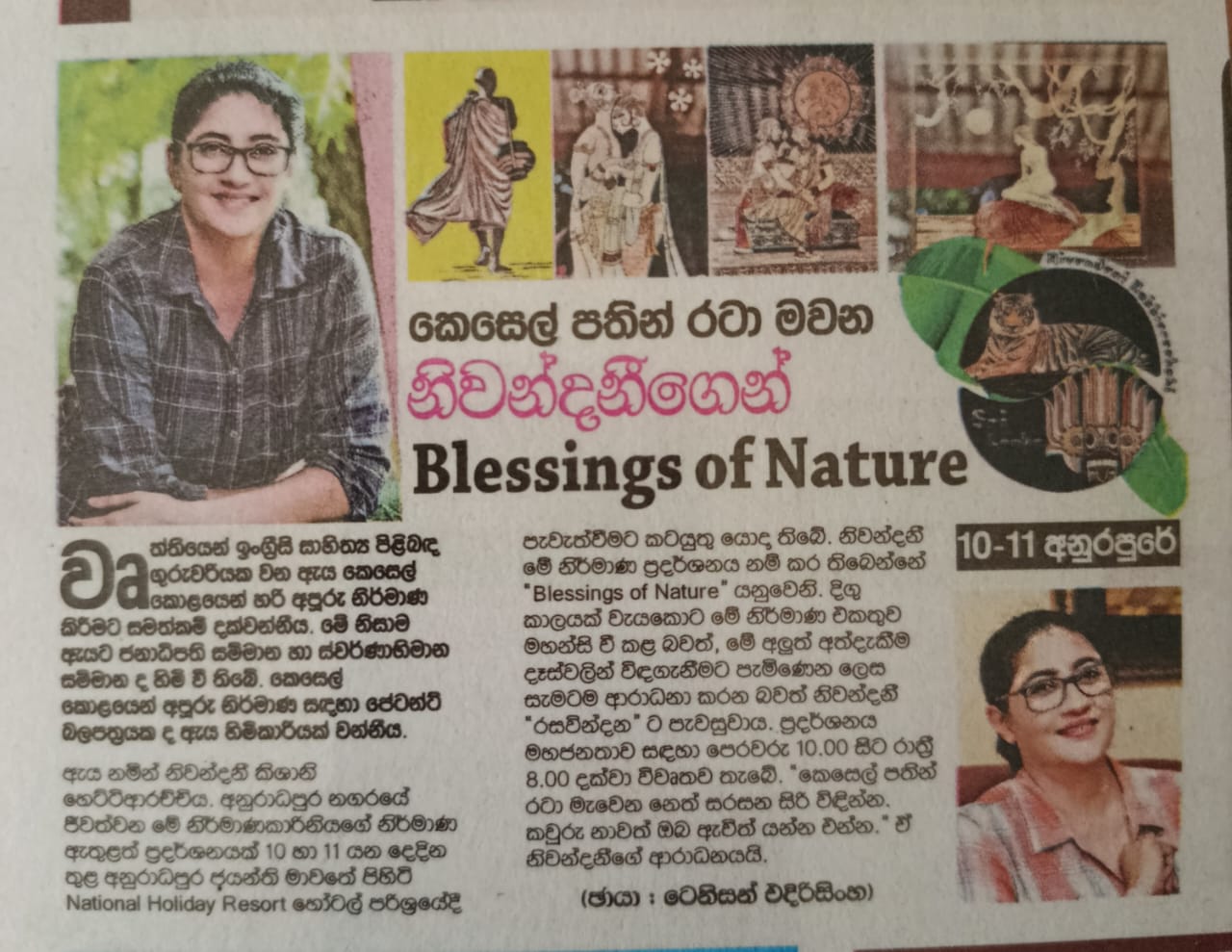
A Royal Artist from Rajarata Creating Masterpieces from Nature’s Waste
In a world dominated by synthetic materials and digital art, Nivandani Krishani Hettiarachchi, an English literature teacher from Talawa, Rajarata, brings to life a rare and breathtaking form of craftsmanship—art made entirely from dried banana leaves.
At first glance, the idea may sound too simple or even impossible. But once you see her intricate, layered, and highly detailed creations, you’ll be left speechless. Nivandani has mastered the technique of transforming discarded banana leaves into textured artworks that resemble three-dimensional paintings.
Where It All Began
Her journey into this unique craft began in childhood with a deep interest in handmade greeting cards using dried flowers and leaves. One day, a Japanese velvet artwork gifted to her friend sparked a life-changing idea. Inspired, Nivandani attempted to recreate something similar using dried banana leaves instead of traditional fabrics.
Her early experiments started with other plant materials like reeds and palm leaves, but an unpleasant odor from the materials turned her away. That’s when she discovered the potential of dried banana leaves from her garden. The smooth texture, the natural shades, and the versatility of the leaf became her medium of expression.
From School Competitions to Presidential Honors
Nivandani’s talent was evident early on. Her first official entry into a school competition in 1989 won her accolades. She later represented her school at an art exhibition organized alongside the Presidential Mobile Service, where her unique art style gained public attention.
Over the years, her banana leaf artwork brought her national recognition, including:
-
Presidential Awards in 2006 and 2010
-
The prestigious Swarnabhimani Award in 2008
-
A rare patent for her banana leaf art technique
-
Over a dozen awards in local and regional competitions
The Teacher Who Shared Her Gift
Nivandani is not only an artist but also a passionate educator. With over 30 years of experience teaching English, she was invited in 2006 by the North Central Provincial Council’s informal education unit to train unemployed youth and adults in her craft.
She embraced the opportunity, teaching art in villages, on television programs, and even to officers in the Navy. Today, her students have carried her techniques across Sri Lanka, spreading the reach of banana leaf art even further.
Blessing of Nature – A Celebration of Her Work
Nivandani’s recent exhibition, titled “Blessing of Nature”, was held at the National Holiday Resort in Anuradhapura on March 10–11. The event showcased nearly 300 of her artworks made entirely from dried banana leaves. Each piece reflects themes of spirituality, philosophy, and natural beauty, shaped by her personal vision.
Interestingly, many of these works were created not with an exhibition in mind, but as a personal hobby, especially during the quiet solitude of the COVID-19 lockdown—a time she describes as the longest and most creative pause in her life.
Support and Gratitude
Behind every great artist is a circle of support. For Nivandani, that support came from her parents, who were artistic in their own right, and her husband Sunil Dissanayake, who remains her biggest pillar of strength. From sourcing materials to framing the artworks, he’s always by her side.
Her daughter, Sandani Dissanayake, is also an English teacher now and proudly follows in her mother’s creative footsteps.
Final Words: A Call for Recognition
Despite her achievements, Nivandani highlights the lack of proper government support for local artisans in Sri Lanka. She dreams of a central hub or gallery where artists like her can sell their creations and inspire the next generation of sustainable creatives.
With her story, Nivandani not only offers a beautiful art form but also shows us how passion, perseverance, and purpose can turn even a discarded banana leaf into a national treasure.